Thursday, October 25, 2012

Diffusion and Osmosis Lab

     Diffusion and Osmosis are very similar and different. In this experiment, we will observe the strengths in their differences.
     As the lab analysis paper says, "molecules only move from regions of higher concentration to lower concentration during diffusion and osmosis. Cells often need to absorb molecules from regions in which concentration of the molecules may be lower than the concentration already inside the cell. The absorption of glucose from blood frequently occurs under these circumstances. Cells use the process of active transport to move substances through the cell membrane against a concentration gradient. Active transport involves proteins in the cell membrane and energy derived from ATP. Diffusion and osmosis do not require any added energy."
     A solution of glucose and starch will be placed inside a bag of dialysis tubing, and we will pour water into the beaker, outside the dialysis bag. We'll let it sit for about 30 minutes, and the solution inside the bialys is tubing and in the beaker were tested for glucose and starch. To test for glucose, we use indicator strips. To test for starch, we use Lugol's solution (iodine and potassium iodide) Starch appears to be a bluish-purple complex with iodine, and glucose does not.


Initial Contents
Initial
Final
Initial
Final
Bag
15% Glucose $ 1% Starch
Clear
Clear and Black
+
+
Beaker
H2O + IKI
Yellow and Brown
Clear
+
+


1. How would you explain the results you obtained? Which substances are entering the bag and which are leaving the bag?
    I believe that the water from the outside of the bag started to seep into the bag. I believe this because a color change, or chemical reaction, took place. I know that such a thing wouldn't happen unless the solution was mixed with another.

2. What evidence could have been collected to show quantitatively that water diffused into the dialysis bag?
    The amount of water outside the bag, and inside the bag. These measurements could have been taken before and after the experiment.

3. What results would you expect if the experiment started with a glucose and IKI solution inside the bag and only starch and water outside?
    The results would be different because the IKI would have mixed differently with the glucose solution than the simple water and iodine mixture did.


Tuesday, October 23, 2012

Cell Membrane Notes

The plasma membrane is common to all cells
Separates:
  Internal living cytoplasmic from
  External environment of cell
Phospholipid bilayer:
  External surface lined with hydrophilic polar heads
  Cytoplasmic surface lined with hydrophilic polar heads
  Non polar, hydrophobic, fatty-acid tails sandwiched between

MEMBRANE MODELS
Fluid-Mosaic Model
Three components:
  Basic membrane referred to as phospholipid bilayer
  protein molecules
    float around like icebergs on a sea
    Membrane proteins may be peripheral or integral
      Peripheral proteins are found on the inner membrane surface
      Integral proteins are partially or wholly embedded (transmembrane) in the membrane
    Some have carbohydrate chains attached
  Cholesterol

How does it do its job?
How does it let stuff through?

It's like a perfume being sprayed. Once the particles get into the air, they spread out more. That's why people across the room can smell just one spray of perfume!

Diffusion: Movement from high concentration to low concentration

Osmosis: diffusion of water across a membrane

What CAN go across a cell membrane WILL go across!

When it is warmer, the molecules move faster. So when it's colder, they must move slower and it's tougher for them to move around.

Thursday, September 27, 2012

Mono Di Poly Experiment

Monosaccharides build everything together and the most simple way to build them up is to join them together to create disaccharides. Then joining those together will give a polysaccharide.

1. We've got to figure out how tests work and what they tell.
     known solutions (mono, di, and poly)
   
MISSION:
Put mono, di, and poly through two tests (to see which ones have reactions)

TWO TESTS

TEST 1- Benedict's Solution (it's blue!)
     in separate test tubes (mono, di, and poly), add sugar solution and a squirt (not drops, but enough to get it visible in the pipettes) of blue benedicts. Heat for approx. 3-5 min. (will be removed from heater when a color change takes place)

(Pipettes in heater)

TEST 2- Iodine Tests (brown)
     in separate test tubes (mono, di, and poly), add sugar solution and a few drops of brown Iodine. Heat for approx. 3-5 min. (to be removed from heater once color change takes place)

BE ABLE TO TELL WHAT MONO, DI, AND POLY DO THROUGH EACH OF THESE TESTS
     When these solutions are put through these tests, a color change takes place! Some respond, and some don't.


-->
SUGAR
BENEDICTS
IODINE
Mono
+
-
Di
-
-
Poly
-
+


Christian knows that it is important to be safe and use an apron, as to protect himself and his clothes from harm's way!
-->
STARCH
BENEDICTS
IODINE
Mono
+
-
Di
-
+
Poly
-
-


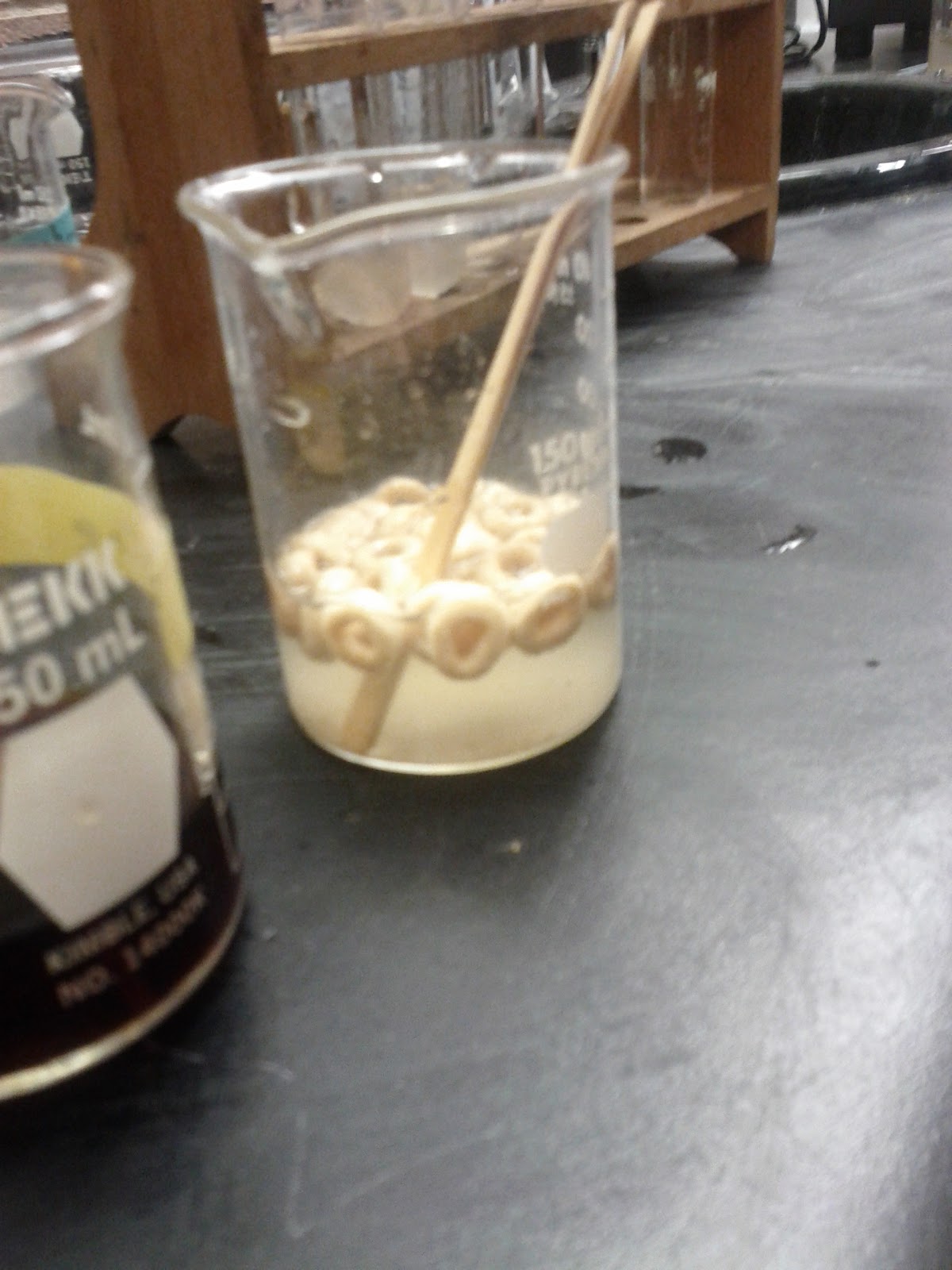
Honey-Nut Scooter juice, anyone?


Carbohydrate Identification Lab Analysis Questions

Use your results from the carbohydrate identification lab and any notes or resources about carbohydrates to answer the following questions:

  1. Name the three categories of carbohydrates studied in this investigation.

In this lab, we used sugar, starch, and fiber.


  1. 2. What three chemical elements are present in all carbohydrates?

Carbon, Hydrogen, and Oxygen.
  1. Give two examples each of the names of sugar molecules from our discussion or the textbook/online that are:
    1. Monosaccharides-Glucose and fructose.
    2. Disaccharides-Lactose and maltose.
    3. Polysaccharides-Starch and glycogen.
  2. How many times larger is the number of hydrogen atoms than oxygen atoms in:
    1. water? The air is 11.1% water.
    2. carbohydrates? Same amount
  3. “Mono” means one, “di” means two, and “poly” means many. Why are these terms used in describing the three types of sugars? Those sugars are made up of one, two, or many different compounds that can be joined together.
  4. How can you tell by using Benedict’s and iodine solutions if a sugar is a
    1. Monosaccharide? Has a reaction.
    2. Disaccharide? Has no reaction.
    3. Polysaccharide? Color turns deep blue.
  5. A certain sugar has no change in color when tested with Benedict’s solution.
    1. Can you tell what type of saccharide it is? Yes!
  6. A certain sugar has a color change in Benedict’s solution.
    1. Can you tell what type of saccharide it is? Yes!
    2. Explain. The different types of reactions (and labels) help me to understand the differences between the saccharides.
  7. Give a examples of foods that contain
    1. Monosaccharides- Fruit, vegetables, and honey
    2. Disaccharides- Milk and yogurt
    3. Polysaccharides- Corn, rice, and bread


Proteins

What all has to do with proteins?
Lots in the body!!
-Hemoglobin (oxygen comes from lungs and the proteins grab onto the oxygen)
-Enzymes (lactose intolerance-people usually missing an enzyme. The job of the enzyme is to degrade the lactose)
-Bacteria (attack it and get rid of it by latching onto antibodies, making antibody proteins. Slurp up those bacteria and "eat them up", basically)
-Hormones (growth, brain. These hormones help to make you taller, or bigger)
-Structure (muscles are nothing but proteins moving across each other and contract or moving them up. Ligaments are long strips of proteins and fibers. Protein is all over in the body. Hairs are remnants of protein)
-Elephant tusks, rhino horns, etc.
-Bones (lots of protein inside the bones)


Protein
* + * = dipeptide     * + * + * = polypeptide
Amino acid

Proteins join with amino acids, and there are around 20 different amino acids!!! Those are:
1. Alanine

6. Glutamine

11. Leucine
16. Threonine
2. Arginine

7. Glutamic acid

12. Lysine
17. Tryptophan
3. Asparagine

8. Glycine

13. Methionine
18. Tyrosine
4. Asparatic acid

9. Histidine

14. Phenylalanine
19. Valine
5. Cysteine

10. Isoleucine

15. Serine
20. Proline


Carbohydrates tend to have mostly the same building block, but proteins can have tons of different building blocks to them! There are many different arrangements of the amino acids that just simply build up different polypeptides. That's why some proteins are growth hormones, or are blobby, stringy, etc.

Proteins aren't in just one straight line of the amino acids, but are basically all over the place. The DNA and RNA will really tell the protein what it needs to do.

(General model of how proteins are made together)
*  +  *  =  * - *  =  * - * - * -*

1. Primary: This is the sequence of peptides.

Helix- spiral
There are places where protein forms into a helix (spirals) and other places where it looks like a sheet. The hydrogen bonds are the reason why those proteins like to curl and make helixes. That is called Secondary Structure.

2. Secondary Structure: This is all about Hydrogen bonds and the chain to polypeptides.

3. Tertiary: All about the R groups connecting and folding the polypeptide.

Each little group of elements in the protein will be attracted to the others like itself.

4. Quaternary: Polypeptides join together.

For the functional protein, it takes four different polypeptides to join together to make a hemoglobin protein.


A Little About Sugar On The Body

Key Words

Monomer-mono, for "one". one monomer.

Polymer- poly, for "many". monomers joined together.

Disaccharide- di, for "two". two saccharides.

polysaccharide-Many saccharides together.

galactose- a type of sugar that's less sweet than glucose

glucose- major source of energy for most cells of the body

C6H12O6
Used as a fuel for the body once the pancreas digests and converts into energy. If the body does not have enough of this, it absorbs sugar from the muscles to maintain energy. But don't have too much of this! The body will be sent into fasting mode and will not use it, but just let it sit there (that's where the stereotype of sweets making you fat came from). But the body still needs it, so eat your sugar in moderation!


A glucose molecule, C6H12O6A 3D rotating glucose molecule

lactose

http://www.chemicalformula.org/glucose


Wednesday, September 26, 2012

Just Some Notes! :)

CARBOHYDRATES + EXAMPLES

Mono saccharides
single sugar molecule glucose, ribose, deoxyribose

disaccharides
contain two monosaccharides joined during dehydration reaction
sucrose

polysaccharides
polymers of monosaccharides
starch, cellulose (in paper), chitin (hard crunchy dead bug leftovers)

Single sugar molecules
Quite soluble and sweet to eat
Ex. Glucose (blood, fructose (fruit) and galactose
     hexoses-six carbon atoms
     isomers of C6 H12 O6
Ribose and deoxyribose (in nucleotides)

DISACCHARIDES
contain two monosaccharides joined by dehydration reaction
soluble and sweet to taste
EX. sucrose-table sugar, maple sugar
-one glucose and one fructose joined by dehydration

POLY saccharides
polymers of monosaccharides
low solubility
not sweet to taste
EX. starch-polymer of glucose
- used for short term energy storage.
plant starch
often branched chain Amylose, corn starch
Animal starch
unbranched
glycogen in liver and muscles
Cellulose
-long, coiled polymer of glucose
-glucoses connected differently than in starch
-structural element for plants
-main component of wood and many natural fivers
-indigestible by most animals
Chitin
-polymer of glucose
-each glucose with an amino group
-very resistant to wear and digestion
-arthropod exoskeletons, cell walls of fungi

LIPIDS
Insoluble in water
-long chains of repeating CH2 units
-renders molecule non-polar
TYPES OF LIPIDS
Fats (long term energy storage and thermal insulation in animals) (butter, lard)
Oils (long term energy storage in plants and their seeds) (cooking oils)
Phospholipids (component of plasma membrane) (nonstick pan spray)
Steroids (component of plasma membrane; hormones) (medicines)
Waxes (wear resistance; retain water) (candles, polishes)

TRIGLYCERIDES (Fat)
-long term energy storage
-backbone of one glycerol molecule
-three-carbon alcohol
-each has an OH group
Three fatty acids attached to each glycerol molecule
-long hydrocarbon chain
-saturated-no double bonds between carbons
-unsaturated. less than 1 double bonds between carbons

Phospholipids
Derived from triglycerides
-Glycerol backbone
-two fatty acids attached instead of three
-third fatty acid replaced by phosphate group
-the fatty acids are non-polar and hydrophobic
-the phosphate group is poly and hydrophilic
Molecules self arrange when placed in water
-polar phosphate "heads" next to water
-non-polar fatty acid "tails"


STEROIDS AND WAXES
Steroids
-cholesterol, testosterone, estrogen
-skeletons of four fused carbon rings
Waxes
-long chain fatty acid bonded to a long chain alcohol
-high melting point
-waterproof
-resistant to degradation


Tuesday, September 25, 2012

fat, fat, FAT!!! (or Triglycerides)

This blog is just a little extra. You might be seeing some big words here. Don't worry, there's a basic idea of what they are next to each of them! Enjoy!

     Fatty acids are made up of Carbon and Hydrogen atoms with an acid group (COOH) at one end. There are over 20 types of fatty acids. These vary by:
     1. Length of chain
     2. If the Carbons have singly or double bonds between them (c-c or c=c)
     3. Total number of double bonds

There are three main types of fatty acids:
     1. Saturated fatty acids-when each Carbon in the fatty chain is bonded with two atoms of Hydrogen, the chain is saturated in Hydrogen. It can't hold any more.

 
 Whole milk has short-chain saturated fatty acids


          Fats made up mostly of saturated fatty acids are called saturated fats.
          You shouldn't have many saturated fats in your diet, as it is not healthy for your heart.
     2. Monounsaturated fatty acids- at one place in the chain, two Carbons are each bonded to one. Hydrogen atom, and are joined twice to eachother.
     Double-Carbon bond means carbons aren't saturated with Hydrogen atoms at that point in the chain. The molecule is called a monounsaturated fatty acid because a double bond occurs at one point in the chain.
     Double bonds cause a kink in the chain of fatty acid. The kink keeps unsaturated fatty acids from packing together tightly, so unsaturated fatty acids are liquid at room temperature.
     Saturated fats are unhealthy, but unsaturated fats are important to your health.


    Oleic acid is a great example of this and is found in olive oil.

     3. Polyunsaturated fatty acids- contains more than double bond and is even less saturated in hydrogen than a monounsaturated fatty acid
this is considered healthy, too

Linoleic acid has two double bonds, polyunsaturated-found in soybean oil


     Your body makes most of the fatty acids it needs except for two, which are both polyunsaturated. You have to take those in through your diet, so they're called essential fatty acids.


Triglycerides
     Triglycerides have 3 fatty acids in them (hence "tri")
     This is the most common found lipid in your body.
     A triglyceride has three chains of fatty acids connected to a glycerol ("backbone")
     That "backbone", or glycerol is a compound that's got Carbon, Hydrogen, and a type of alchohol.
     The more commonly used name for a triglyceride is FAT.
     Most of your intake are in the form of a fat.


Oils are lipids at room temperature.


Phospholipids
     These have Phosphate in them (hence "phospho")
     The glycerol backbone has 2 fatty acids and a phosphate group!
     The part where phosphate is attached to the glyscerol is the head, hydrophilic ("hydro", for water. "philic", for loving. So this means "water loving").

Sterols
     These are lipids with no glycerol or fatty acids.
     They're composed mainly of 4 connecting rings of Carbon and Hydrogen.
     The most commonly known Sterol is Cholesterol.
     But don't worry about taking in the specific, or "right" amount of cholesterol, because your body makes all the cholesterol it needs!

Once more...
ADORABLE KITTY!